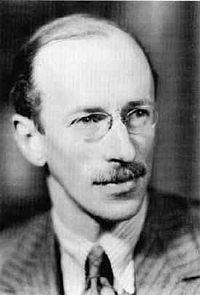
Basil H. Liddell Hart Quotes
Captain Liddell Hart Quotations
Basil Henry Liddell Hart
Also known as Captain B. H. Liddell Hart. English soldier, author, military historian and military strategist.
Lived: 1895–1970
(visit wikipedia to learn more about Sir Basil Henry Liddell Hart)

Military Related Sir Basil Henry Liddell Hart Quotes
“The hydrogen bomb is not the answer to the Western peoples’ dream of full and final insurance of their security … While it has increased their striking power it has sharpened their anxiety and deepened their sense of insecurity.”
– Sir Basil H. Liddell Hart
In war the chief incalculable is the human will, which manifests itself in resistance, which in turn lies in the province of tactics. Strategy has not to overcome resistance, except from nature. Its purpose is to diminish the possibility of resistance, and it seeks to fulfill this purpose by exploiting the elements of movement and surprise.
– Sir Basil H. Liddell Hart
For even the best of peace training is more theoretical than practical experience … indirect practical experience may be the more valuable because infinitely wider.
– Sir Basil H. Liddell Hart
…the predominance of moral factors in all military decisions. On them constantly turns the issue of war and battle. In the history of war they form the more constant factors, changing only in degree, whereas the physical factors are different in almost every war and every military situation.
– Sir Basil H. Liddell Hart
the most consistently successful commanders, when faced by an enemy in a position that was strong naturally or materially, have hardly ever tackled it in a direct way. And when, under pressure of circumstances, they have risked a direct attack, the result has commonly been to blot their record with a failure.
– Sir Basil H. Liddell Hart
Natural hazards, however formidable, are inherently less dangerous and less uncertain than fighting hazards. All ocnditions are more calculable, all obstacles more surmountable than those of human resistance.
– Sir Basil H. Liddell Hart
The most effective indirect approach is one that lures or startles the opponent into a false move — so that, as in ju-jitsu, his own effort is turned into the lever of his overthrow.
– Sir Basil H. Liddell Hart
The downfall of civilized states tends to come not from the direct assaults of foes, but from internal decay combined with the consequences of exhaustion in war.
– Sir Basil H. Liddell Hart
In a campaign against more than one state or army, it is more fruitful to concentrate first against the weaker partner than to attempt the overthrow of the stronger in the belief that the latter’s defeat will automatically involve the collapse of the others.
– Sir Basil H. Liddell Hart Quotes
While hitting one must guard … In order to hit with effect, the enemy must be taken off his guard.
– Sir Basil H. Liddell Hart Quotes
For whoever habitually suppresses the truth in the interests of tact will produce a deformity from the womb of his thought.
– Sir Basil H. Liddell Hart
The military weapon is but one of the means that serve the purposes of war: one out of the assortment which grand strategy can employ.
– Sir Basil H. Liddell Hart
While there are many causes for which a state goes to war, its fundamental object can be epitomized as that of ensuring the continuance of its policy — in face of the determination of the opposing state to pursue a contrary policy. In the human will lies the source and mainspring of conflict.
– Sir Basil H. Liddell Hart
It is thus more potent, as well as more economical, to disarm the enemy than to attempt his destruction by hard fighting … A strategist should think in terms of paralyzing, not of killing.
– Sir Basil H. Liddell Hart
While the nominal strength of a country is represented by its numbers and resources, this muscular development is dependent on the state of its internal organs and nerve-system — upon its stability of control, morale, and supply.
– Sir Basil H. Liddell Hart
To ensure attaining an objective, one should have alternate objectives. An attack that converges on one point should threaten, and be able to diverge against another. Only by this flexibility of aim can strategy be attuned to the uncertainty of war.
– Sir Basil H. Liddell Hart
The higher level of grand strategy [is] that of conducting war with a far-sighted regard to the state of the peace that will follow.
– Sir Basil H. Liddell Hart
The nearer the cutting off point lies to the main force of the enemy, the more immediate the effect; whereas the closer to the strategic base it takes place, the greater the effect.
– Sir Basil H. Liddell Hart
As has happened so often in history, victory had bred a complacency and fostered an orthodoxy which led to defeat in the next war.
– Sir Basil H. Liddell Hart
(Strategy, 1954; discussing the French army between the World Wars)
Their strength became split in diverging directions — due partly to divided minds at the top, but also, ironically, to dazzling initial success in all directions. Instead of keeping a single line of operation that threatened alternate objectives, they were led to pursue several lines of operation, each too obviously aiming at a single objective, which thus became easier for the defender to cover. Moreover, in each case the attacker’s direction became obvious at the same time that his drive was becoming a precarious stretch of his own supply line.
– Sir Basil H. Liddell Hart
(Strategy, 1954; on German failure in WWII)
This high proportion of history’s decisive campaigns, the significance of which is enhanced by the comparative rarity of the direct approach, enforces the conclusion that the indirect is by far the most hopeful and economic form of strategy.
– Sir Basil H. Liddell Hart
The more closely [the German army] converged on [Stalingrad], the narrower became their scope for tactical manoeuvre as a lever in loosening resistance. By contrast, the narrowing of the frontage made it easier for the defender to switch his local reserves to any threatened point on the defensive arc.
– Sir Basil H. Liddell Hart
– Sir Basil H. Liddell Hart
The more usual reason for adopting a strategy of limited aim is that of awaiting a change in the balance of force … The essential condition of such a strategy is that the drain on him should be disproportionately greater than on oneself.
– Sir Basil H. Liddell Hart
To foster the people’s willing spirit is often as important as to possess the more concrete forms of power.
– Sir Basil H. Liddell Hart
The effect to be sought is the dislocation of the opponent’s mind and dispositions — such an effect is the true gauge of an indirect approach.
– Sir Basil H. Liddell Hart
No man can exactly calculate the capacity of human genius and stupidity, nor the incapacity of will.
– Sir Basil H. Liddell Hart
In the case of a state that is seeking not conquest but the maintenance of its security, the aim is fulfilled if the threat is removed — if the enemy is led to abandon his purpose.
– Sir Basil H. Liddell Hart Quotes
The aim is not so much to seek battle as to seek a strategic situation so advantageous that if it does not of itself produce the decision, its continuation by a battle is sure to achieve this. In other words, dislocation is the aim of strategy.
– Sir Basil H. Liddell Hart
Direct pressure always tends to harden and consolidate the resistance of an opponent.
– Sir Basil H. Liddell Hart Quotes
For if we merely take what obviously appears the line of least resistance, its obviousness will appeal to the opponent also; and this line may no longer be that of least resistance. In studying hte physical aspect, we must never lose sight of the psychological, and only when both are combined is the strategy truly an indirect approach, calculated to dislocate the opponent’s balance.
– Sir Basil H. Liddell Hart
It is folly to imagine that the aggressive types, whether individuals or nations, can be bought off … since the payment of danegeld stimulates a demand for more danegeld. But they can be curbed. Their very belief in force makes them more susceptible to the deterrent effect of a formidable opposing force.
– Sir Basil H. Liddell Hart
An army should always be so distributed that its parts can aid each other and combine to produce the maximum possible concentration of force at one place, while the minimum force necessary is used elsewhere to prepare the success of the concentration.
– Sir Basil H. Liddell Hart
In any problem where an opposing force exists and cannot be regulated, one must foresee and provide for alternative courses. Adaptability is the law which governs survival in war as in life … To be practical, any plan must take account of the enemy’s power to frustrate it; the best chance of overcoming such obstruction is to have a plan that can be easily varied to fit the circumstances met;
– Sir Basil H. Liddell Hart
The unexpected cannot guarantee success, but it guarantees the best chance of success.
– Sir Basil H. Liddell Hart
Air forces offered the possibility of striking a the enemy’s economic and moral centers without having first to achieve ‘the destruction of the enemy’s main forces on the battlefield’. Air-power might attain a direct end by indirect means — hopping over opposition instead of overthrowing it.
– Sir Basil H. Liddell Hart
It should be the aim of grand strategy to discover and pierce the Achilles’ heel of the opposing government’s power to make war. Strategy, in turn, should seek to penetrate a joint in the harness of the opposing forces. To apply one’s strength where the opponent is strong weakens oneself disproportionately to the effect attained. To strike with strong effect, one must strike at weakness.
– Sir Basil H. Liddell Hart
With growing experience, all skillful commanders sought to profit by the power of the defensive, even when on the offensive.
– Sir Basil H. Liddell Hart
Inflict the least possible permanent injury, for the enemy of to-day is the customer of the morrow and the ally of the future
– Sir Basil H. Liddell Hart Quotes
If you find your opponent in a strong position costly to force, you should leave him a line of retreat as the quickest way of loosening his resistance. It should, equally, be a principle of policy, especially in war, to provide your opponent with a ladder by which he can climb down.
– Sir Basil H. Liddell Hart Quotes
It is only to clear from history that states rarely keep faith with each other, save in so far (and so long) as their promises seem to them to combine with their interests.
– Sir Basil H. Liddell Hart Quotes
The implied threat of using nuclear weapons to curb guerrillas was as absurd as to talk of using a sledge hammer to ward off a swarm of mosquitoes.
– Sir Basil H. Liddell Hart
War is always a matter of doing evil in the hope that good may come of it.
– Sir Basil H. Liddell Hart quotes
I can’t guarantee that these quotations are correct or true, but I have tried to verify as many of the quotes by Sir Basil H. Liddell Hart as possible. Please contact me if you find any errors in the Sir Basil H. Liddell Hart quotes, have some additional information about them or if you know any quotations from Sir Basil H. Liddel-Hart that are not listed here.
Submit your own quotes/quotations in our quotes forum
