
You are using an out of date browser. It may not display this or other websites correctly.
You should upgrade or use an alternative browser.
You should upgrade or use an alternative browser.
Main Battle Tanks
Pale Rider
Active member
Which comment?
The first.

Gator
U of B and B Alumnus
.Dual Purpose and Sabot Rounds are easier to come by than Interchangable Caliber Tubes.
Are you basing that comment on the U.S still sitting with the mind set that we will only engage former Eastern block armor threats.
Dual Purpose and Sabot Rounds are easier to come by than Interchangable Caliber Tubes. The Tubes being Changed would mean new sized ammo Rounds, how many Rounds does a Tank carry now? How many more could a Tank carry if different sizes were needed? Would they all fit nicely inside the Ammo Storage Compartment of the Tank? Or would the Tank need different Compartments for different sized Rounds? What about the Auto-Loader, would that need to be switched out as well?
As for Tanks, doesnt matter who the US fights, I believe large scale Tank on Tank Battles are a thing of the past, and, Tanks are, in my opinion, not good for City Fighting when large groups of Terrorists are involved and intermixed with Civilians, which makes the MBT not a good use of limited Tax Dollars, in my own opinion.
Missiles are more common on the Battlefield, and one doesnt even need the Delivery System of a Missile now, all one needs is the EFP Warhead, or an EFP IED.
I believe the SP Gun is the best use of Military Funds. The SP Gun can be used as a highly mobile Firebase, if I had my way I'd bring back the 8 inch SP Guns, and the 175MM SP Guns, to be used along with the 155MM SP Gun.

Supostat
Active member
However, in Chechnya actually tanks were used often to sweep out terrorists/rebels of houses in which they were fortified. 30mm HE rounds of BMP-2 cannon was not powerful enough, and artillery did no provide accuracy enough to hit a certain building. Then tank was driven into position and made a one or more direct hits into target with its 125mm HE rounds..As for Tanks, doesnt matter who the US fights, I believe large scale Tank on Tank Battles are a thing of the past, and, Tanks are, in my opinion, not good for City Fighting when large groups of Terrorists are involved and intermixed with Civilians, which makes the MBT not a good use of limited Tax Dollars, in my own opinion.
Missiles are more common on the Battlefield, and one doesnt even need the Delivery System of a Missile now, all one needs is the EFP Warhead, or an EFP IED.
I believe the SP Gun is the best use of Military Funds. The SP Gun can be used as a highly mobile Firebase, if I had my way I'd bring back the 8 inch SP Guns, and the 175MM SP Guns, to be used along with the 155MM SP Gun.
Gator
U of B and B Alumnus
However, in Chechnya actually tanks were used often to sweep out terrorists/rebels of houses in which they were fortified. 30mm HE rounds of BMP-2 cannon was not powerful enough, and artillery did no provide accuracy enough to hit a certain building. Then tank was driven into position and made a one or more direct hits into target with its 125mm HE rounds.
When I was an Engineer we had a 165mm Demolition Gun on what was called the CEV, the Combat Engineer Vehicle.....
Looked like this
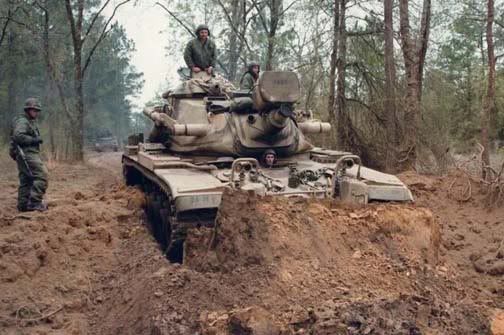
Not a MBT, not anything close to it, but it sure got the job done as far as the Battlefield Engineer Mission, and, with 165MM HESH (High Explosive Squash Head) Round, we could do a lot of damage with that puppy.
We could also clear Minefields with it and a host of other Engineer missions.
You think something like that would have gotten the job done in Chechnya?
Supostat
Active member
Nop, ordinary (common) T-62/72/80:We could also clear Minefields with it and a host of other Engineer missions.
You think something like that would have gotten the job done in Chechnya?
http://www.pbase.com/igor01/image/1744281/original
Of course, if possible artillery also was used, but the point was that MBT still can be useful in anti-guerilla war.
Last edited:
Pale Rider
Active member
.
Dual Purpose and Sabot Rounds are easier to come by than Interchangable Caliber Tubes. The Tubes being Changed would mean new sized ammo Rounds, how many Rounds does a Tank carry now? How many more could a Tank carry if different sizes were needed? Would they all fit nicely inside the Ammo Storage Compartment of the Tank? Or would the Tank need different Compartments for different sized Rounds? What about the Auto-Loader, would that need to be switched out as well?
As for Tanks, doesnt matter who the US fights, I believe large scale Tank on Tank Battles are a thing of the past, and, Tanks are, in my opinion, not good for City Fighting when large groups of Terrorists are involved and intermixed with Civilians, which makes the MBT not a good use of limited Tax Dollars, in my own opinion.
Missiles are more common on the Battlefield, and one doesnt even need the Delivery System of a Missile now, all one needs is the EFP Warhead, or an EFP IED.
I believe the SP Gun is the best use of Military Funds. The SP Gun can be used as a highly mobile Firebase, if I had my way I'd bring back the 8 inch SP Guns, and the 175MM SP Guns, to be used along with the 155MM SP Gun.
Interchangable gun tube technology has been around now for quite some time especially with the U.S, this is most likely the type of gun system that we will replace the M256 with when the M1A3 makes it debut, the breech and recoil mechanism will be able to use a 120 or 140 mm gun tube. A gun tube is really not that difficult to change out on a M1 or LEO 2 series tank, pop out 2 retaining pins rotate it out of the buttress threads and slide it out and replace. Also the M1A3 will most likely sport a universal automatic loading system that will be housed in the rear turret area. This gun system should also work on the FCS system also by using lighter alloys such as titanium for strength.
We are pretty much at our limits with 120mm KE projectiles including DU alloy, the key to engaging a opponents armor is at the max distance as possible, we have always settled for the 2000 meter engagement range and with the possibility of future ballistic armor designs being researched by some countries we may be hard pressed to maintain that goal. ETC technology is still around 10 - 15 years from having a gun system that will withstand the battlefield environment and a 140mm will give close performance levels to that system.
Everyone is under the impression that all future conflicts will be small scale operations only, but our potential future opponents keep mass producing tanks like there is no tomorrow, some of these militaries are no pushovers like what was the case of Iraq, they know how to fight a air land battle doctrine also and they have the technology to back it up. You will see the U.S Army and U.S Marines keeping their heavy sleds for quite along time.
Also we are fighting smarter now in Iraq with vehicles that are better capable in a urbanized environment versus having to use a tank.
Here is a proto type M1A3 and a future M1 series auto loader
Last edited:
Supostat
Active member
MBT still can be used in urban areas, but it requires appropriate tactics, in general from nearby infantry.Also we are fighting smarter now in Iraq with vehicles that are better capable in a urbanized environment versus having to use a tank.
How about US plans to introduce a full-effect HE rounds for 120mm `Rheinmetall` instead of dual purpose HEATs? Does such idea exist?
Pale Rider
Active member
MBT still can be used in urban areas, but it requires appropriate tactics, in general from nearby infantry.
How about US plans to introduce a full-effect HE rounds for 120mm `Rheinmetall` instead of dual purpose HEATs? Does such idea exist?
Agreed - tanks can be used when dealing with enemy strong points just as long that you can provide flank and rear security for it, using them for patroling or convoy escort duty does nothing but turn it into a moving target. Other vehicles are better adapted for this type of scenario and are being fielded by Russia and the U.S as you know.
We have all kinds of different projectiles in the works for the M256/L44, the problem with my Defense Department is that it takes them way too long to field something, here is some of the ones we may see.
M-830 MPAT Airburst projectile
M-1028 Cannister projectile
M-1069 Full bore Multi purpose.
Gator
U of B and B Alumnus
Agreed - tanks can be used when dealing with enemy strong points just as long that you can provide flank and rear security for it, using them for patroling or convoy escort duty does nothing but turn it into a moving target. Other vehicles are better adapted for this type of scenario and are being fielded by Russia and the U.S as you know.
We have all kinds of different projectiles in the works for the M256/L44, the problem with my Defense Department is that it takes them way too long to field something, here is some of the ones we may see.
M-830 MPAT Airburst projectile
M-1028 Cannister projectile
M-1069 Full bore Multi purpose.
Airburst can be accomplished with fuzing on a standard HE Round, by way of a MTSQ or VT Fuze. The PD Fuze on the same Round would be good for Hardened Targets such as a House or Bunkers.
With everyone going big on Armor and Crew Protection, I believe the HVAPDS to still be the best for AT.
Canister Projectiles have been around for a long, long time, they were used in the Civil War here in the US, a lot like the Grape Shot also used.
I'm a big fan of the Flechette Round myself.
Tungsten is nice, but expensive, and, hard to come by in the US. Seems China has the largest deposits of Tungsten, and I do not believe it wise for the United States to be dependent on other Nations for National Defense Systems.
I believe the reason it takes the DoD so long to put something out into the Field is everyone keeps trying to reinvent the wheel, so to speak.
Pale Rider
Active member
Airburst can be accomplished with fuzing on a standard HE Round, by way of a MTSQ or VT Fuze. The PD Fuze on the same Round would be good for Hardened Targets such as a House or Bunkers.
With everyone going big on Armor and Crew Protection, I believe the HVAPDS to still be the best for AT.
Canister Projectiles have been around for a long, long time, they were used in the Civil War here in the US, a lot like the Grape Shot also used.
I'm a big fan of the Flechette Round myself.
Tungsten is nice, but expensive, and, hard to come by in the US. Seems China has the largest deposits of Tungsten, and I do not believe it wise for the United States to be dependent on other Nations for National Defense Systems.
I believe the reason it takes the DoD so long to put something out into the Field is everyone keeps trying to reinvent the wheel, so to speak.
We were using the M393A1s in South Korea up until 1985, then it went away, the unit I was with got the chance to shoot all of them down range along with our M392s and WP rounds, the M774s were given to the South Koreans and we switched over to the M833.
China is going out of their way at the present moment on grabbing up as much of the special metals that they can get their hands on.
Last edited:
Com systems & robust data processing
Hi Supostat,
In post 16 of this thread, mention was lightly made of a discreet communications technique, the resulting systems would be immune to detection, blocking, jamming and monitoring. Over the years, this subject has been raised with a number of bodies such as those that define Military R&D programs, but has not gone any further and is one of a pair of techn ologies conceived as component systems of advanced combat robotics.
Essentially, this introduces fly-by-wire without the wire; as a result, controls need no longer be anywhere near the sensors and actuators that provide input and control data feeds.
These are far more than a system that would enable remote control, had this technology been in place at the time of 9/11, this event could not have taken place and it should be recognised, it could easily have been in place long before that date.
nero1234
Hi Supostat,
In post 16 of this thread, mention was lightly made of a discreet communications technique, the resulting systems would be immune to detection, blocking, jamming and monitoring. Over the years, this subject has been raised with a number of bodies such as those that define Military R&D programs, but has not gone any further and is one of a pair of techn ologies conceived as component systems of advanced combat robotics.
Essentially, this introduces fly-by-wire without the wire; as a result, controls need no longer be anywhere near the sensors and actuators that provide input and control data feeds.
These are far more than a system that would enable remote control, had this technology been in place at the time of 9/11, this event could not have taken place and it should be recognised, it could easily have been in place long before that date.
nero1234
I hate to be conservative, espcially when i feel my self sounding like a cavalry officer in 1916....("These funny looking metal boxes can never replace the shock of cold steel).
However, as a tank commander in the IDF i have to say a few things...
1. Thoguh all out wars with massive tank fleets seem a thing of the past, i wouldent put my money on it... After WWI all out war in europe with millions of soldiers seemed a thing of the past. When big players decide to play against each other(Russia Vs China, India Vs. Pakistan, Israel Vs. Egypt/Syria...) one of the weapons of chice will have to be the tank. Nothing takes the fight to the enemy like an armoured brigade, nothing.
2. Unamanned turrets scare me. As a tank commander i am taught to use my eyes to locate the enemy, and see the terrain. I dont see how and opics will allow me to see as well as with my head outside.
3. Autolaoders... I feel the same about them as i feel about unmanned turrets. I dont know about loaders in your army...But my loader is preetey fast, and dose good work with his MG. Not to speak of the 60mm mortar. And when you have 3 men to maintain your tank, it takes more time than a 4 men crew...
just my thoughts.
However, as a tank commander in the IDF i have to say a few things...
1. Thoguh all out wars with massive tank fleets seem a thing of the past, i wouldent put my money on it... After WWI all out war in europe with millions of soldiers seemed a thing of the past. When big players decide to play against each other(Russia Vs China, India Vs. Pakistan, Israel Vs. Egypt/Syria...) one of the weapons of chice will have to be the tank. Nothing takes the fight to the enemy like an armoured brigade, nothing.
2. Unamanned turrets scare me. As a tank commander i am taught to use my eyes to locate the enemy, and see the terrain. I dont see how and opics will allow me to see as well as with my head outside.
3. Autolaoders... I feel the same about them as i feel about unmanned turrets. I dont know about loaders in your army...But my loader is preetey fast, and dose good work with his MG. Not to speak of the 60mm mortar. And when you have 3 men to maintain your tank, it takes more time than a 4 men crew...
just my thoughts.

mmarsh
Active member
I hate to be conservative, espcially when i feel my self sounding like a cavalry officer in 1916....("These funny looking metal boxes can never replace the shock of cold steel).
However, as a tank commander in the IDF i have to say a few things...
1. Thoguh all out wars with massive tank fleets seem a thing of the past, i wouldent put my money on it... After WWI all out war in europe with millions of soldiers seemed a thing of the past. When big players decide to play against each other(Russia Vs China, India Vs. Pakistan, Israel Vs. Egypt/Syria...) one of the weapons of chice will have to be the tank. Nothing takes the fight to the enemy like an armoured brigade, nothing.
2. Unamanned turrets scare me. As a tank commander i am taught to use my eyes to locate the enemy, and see the terrain. I dont see how and opics will allow me to see as well as with my head outside.
3. Autolaoders... I feel the same about them as i feel about unmanned turrets. I dont know about loaders in your army...But my loader is preetey fast, and dose good work with his MG. Not to speak of the 60mm mortar. And when you have 3 men to maintain your tank, it takes more time than a 4 men crew...
just my thoughts.
Sherman
1. But doesn't eliminating the 4th crewman mean you can theoretically put more tanks onto the battlefield?
2. The thing about autoloaders, its weird some guys I have spoken to hate them others don't. Its true that the early Soviet autoloaders would "attempt to load the gunner into the gun" (quote Cadet Seaman) but you take a tank like the French Leclerc which as had a very good record with its autosystem. Seems it depends on the actual tank. In theory at least reducing the number of crew is a good thing.

A Can of Man
Je suis aware
is it just me or did some posts here get deleted/modified?
1. But doesn't eliminating the 4th crewman mean you can theoretically put more tanks onto the battlefield?
2. The thing about autoloaders, its weird some guys I have spoken to hate them others don't. Its true that the early Soviet autoloaders would "attempt to load the gunner into the gun" (quote Cadet Seaman) but you take a tank like the French Leclerc which as had a very good record with its autosystem. Seems it depends on the actual tank. In theory at least reducing the number of crew is a good thing.
yes, but again, maitainance is a ***** and the loader is usually the commanders right hand...

Pale Rider
Active member
You would push the ammunition select button, works along the same lines on what is used on a carousel or a bustle mounted system.

Damien435
Active member
Autoloader: Thousands of moving parts.
Loader: One moving part.
Which one is more prone to failure? Sure the autoloader can't show up for duty drunk, but in most armies neither can the loader. An autoloader just adds one more piece of equipment for the crew to maintain with one fewer pair of hands to work on it. Every member of a tank crew is required to be a shade tree mechanic and is generally field promoted to grease monkey within a few months. Performance wise I am sure the autoloader can match the human loader, but it's the out of combat situations where a loader comes in handy, such as maintenance, and an autoloader probably doesn't make a very good wingman.
Loader: One moving part.
Which one is more prone to failure? Sure the autoloader can't show up for duty drunk, but in most armies neither can the loader. An autoloader just adds one more piece of equipment for the crew to maintain with one fewer pair of hands to work on it. Every member of a tank crew is required to be a shade tree mechanic and is generally field promoted to grease monkey within a few months. Performance wise I am sure the autoloader can match the human loader, but it's the out of combat situations where a loader comes in handy, such as maintenance, and an autoloader probably doesn't make a very good wingman.
Pale Rider
Active member
Auto loaders are quite reliable and do have emergency back up procedures in place. We may see a auto loader in the M1A3 upgrade while still retaining a 4 man crew. The 4 man crew versus a 3 man crew is always subject for a good debate with pros and cons on both approaches, when bigger mainguns are fielded you will not have a choice in going the auto loader route.