| |
| | Post 11 |
| Tribunus Laticlavius | Does this one count - 13 Nov 1917? It was a drawn bayonet charge. DURING the last full charge ever made by the British cavalry, the officer leading the advance turned to a corporal galloping beside him and asked how things were going. The corporal replied: “Sir, it’s my birthday today and the best I’ve ever spent.” The remark was typical of the selfless courage shown by the heroic troops during the horseback advance on Jerusalem in the First World War – an event to be commemorated at a special service tomorrow. The officer was Colonel Sir Randolf Baker, and his grandson, James Gibson-Fleming, will read a lesson at the service. The cavalry charge took place on November 13 1917 against Turkish troops entrenched across two miles of open ground towards Jerusalem. The last British Army cavalry charge was at the Battle of El Mughar, near Jerusalem, on 13 November 1917. The Buckinghamshire Hussars, supported by the Dorset and Berkshire Yeomanry Regiments, overran a Turkish position, taking several hundred prisoners. The last British Army cavalry charge was at the Battle of El Mughar, near Jerusalem, on 13 November 1917. The Buckinghamshire Hussars, supported by the Dorset and Berkshire Yeomanry Regiments, overran a Turkish position, taking several hundred prisoners. *
__________________ . I’ve been a puppet, a pauper, a pirate, a poet, a pawn and a king. I've been up and down and over and out and I know one thing . Each time I find myself flat on my face I pick myself up and get back in the race. Last edited by Del Boy : November 10th, 2007 at 14:15. |
| |
| | Post 12 | ||
| Tribunus Laticlavius | Quote:
This is alleged to be the last, possibly the only and definitely the longest, mounted Infantry charge. These units were not armed with the traditional cavalry weapons, of sabres and lances. It appears from all references that I can find that the Bucks and Dorsets charged as cavalry unit, not using bayonets until they dismounted. Mounted Infantry were only armed with rifles and bayonets and under normal circumstances would ride to the battle area, dismount and fight on foot as regular infantry while the horses were moved to the rear, however on this occasion the Turks had a clear field of fire of over 7000 yards so it was decided to charge on horseback. Quote:
__________________ "Too thick to change, and too old to care" http://www.geocities.com/senojekips/Index.htm | ||
| |
| | Post 13 |
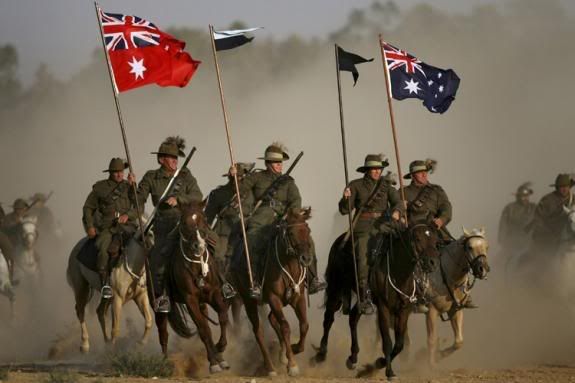
| Tribunus Laticlavius | Yes, senojekips, you are likely correct. It was first swords, then off horses and a charge with fixed bayonets. The picture of the charge shows drawn swords. "It began at 3pm and, as many horses tired on the difficult terrain, the troops refused to give up, dismounted and continued the charge on foot up a hill with fixed bayonets. The men of the Bucks Yeomanry scrambled up the bank of a wadi to cross 3000 yards of open ground near the village of El Mughar. The Dorset Yeomanry, meanwhile, covered 4000 yards, more than 2 miles, before dismounting and continuing on foot. The battle was won by the evening and the British captured the enemy guns. British troops would never make a full charge on horseback again. Just weeks late tanks took over. The regiment won two Distinguished Service Orders, one Military Cross, three Distinguished Conduct Medals and seven Military Medals. The Bucks Yeomanry won one DSO and one MC. Col. Baker was 38, he had been in charge of a beach at Gallipoli, and was then wounded by a shell, but went to Egypt with his regiment. Horses were used alongside tanks at the battle of Amiens in August 1918 and we had a cvalry division in Palestine until 1940." At their commemorative service today, 11 Nov 2007, the last post will be sounded by a trumpeter from the Band of the Light Cavalry. - Last edited by Del Boy : November 11th, 2007 at 13:02. |
| |