![]() | About Is Iran a Threat? Page 2 |
![]() |
| | #11 |
| | LeEnfield Rides again |
![]() | |
| |
| | #12 |
| |
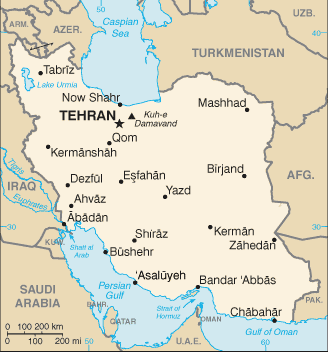
"unstable government " = "government not under our control".??? And if the world would be better off if the crackpot countries in the Middle East didn't have nukes, how come you are so sure that Israel is an exception? The US and most of the rest of the world think that Iran is an unstable country in an unstable region and that it would be a bad idea for all the countries in that region to have nuclear weapons to threaten each other with. Its a fair point, but I don't think Iran can be stopped because it has a history of being pushed around by the US and the UK and it sees nukes as the only way to guarantee its sovereignty. What is unstable about Iran? Its been the same regime for 30+ years. Iranian politicans talk tough, but they have actually proven themselves to be masterful negotiators behind the scenes and would you want to enter war against a country if you had 4% of the military budget of your opponent? And if the last two countries your enemy had attacked had ended up as devastated as Iraq and Afghanistan? Lastly, take a good long look at the map of the Middle East. If you were Iran, how would the Middle East look to you? Iran is surrounded by nations that have large United States bases. Iraq has American bases.- Turkey has American bases. - Pakistan has American bases. - Afghanistan has American bases. - Saudi Arabia has American bases. - Kuwait has American military bases. - Qatar has American military bases. - Uzbekistan has American military bases. And as for Israel, well, let’s just say that this is the one item that Republicans and Democrats agree on: that the United States stands "lockstep" with supposedly our closest ally. In short, Iran is surrounded by a sea of American military bases. And why exactly are we sliding to a war with Iran? Why are we so hell-bent on persuading ourselves that it is Iran that poses a threat to us? Hot air is good for balloons, not so good for sound policy. And not so good for living in a peaceful world. |
| | #13 | |
| | Quote:
Adversus solem ne loquitor | |
| | #14 |
| |
Nuclear weapons are overrated and excessively feared. Nuclear weapons are devastating but conventional weapons and all out conventional war needs to be feared more that it is. Modern conventional weapons can be used in an unrestricted way that would provide a more controlled destruction of an enemy nation. What is required is air superiority and the willingness to use conventional weapons fully. A military with air superiority can impose a Carthaginian solution upon its enemy. Rome destroyed its enemy Carthage at the end of their third war. Rome killed or sold into slavery the Carthaginians. They salted the land. Something akin to Stalin's scorched earth tactic except it would be scorching the opponents land. I do not suggest that conventional weapons should be used in the way that I will describe, but I illustrate how simple it is to achieve total devastation without using nuclear weapons. This is a hypothetical scenario! 1. First use your air force to destroy the opponents air force and air defences 2. Then use your air force to destroy bridges, airports, ports, and key parts of rail and roads to hinder movement within and out of the enemy territory. Blockade the country with Navy and Army forces. 3. Use your air force to destroy medical and emergency response infrastructure. 4. Drop poisons into water and food supplies or bomb food and water supplies and distribution. Use the air force to help spread certain diseases (Cholera and Malaria etc...) that devastate refugee populations but which do not effect populations with proper medical facilities. The percentage of the target population that would be killed with this approach would equal the devastation of a nuclear attack. The devastation could be achieved in a matter of weeks and there would not be the risk of fallout and other spillover effects that come with the use of nuclear weapons. |
| | #15 |
| |
Always knew that you MI guys were without morals. |
| | #16 | |
| | Quote:
| |
| | #17 | |
| | Quote:
| |
| | #18 |
| |
I think we forget one major application of nuclear weapons : threaten. What would happen if Iran threatens Germany to fire a nuclear weapon on Berlin as a retaliation to sanctions, a German book that grossly insults Islam or not implementing sharia law in muslim neigbourhoods. You would say it's bluff, but you are not the only person living in Germany. How would the press react? We know they overreact probably causing some panic. And what will the German government do? They will think Iran is bluffing but will they take the gamble? What about citizens who are scared to death? About the stability of Iran. Not so long ago they brutally surpressed an uprising. What will happen in Iran when Assad's regime in Syria falls? The next domino or are they prepared to take extreme measures for the survival of Assad and their own. I am very sceptical about the outcome in the ME. Everyone is positioning themselves. There are a lot of bulls walking in the china shop. |
| | #19 |
| |
Iran only needs to launch one missile with an atom bomb on it, and life will change as we know it. You can bomb what ever you like in Iran, but brown stuff would hit the fan in grand style and at least one country would hit back with more than one missile.
|
| | #20 | |||||
| | Quote:
Quote:
Have you heard about the Bundesnachrichtendienst? - The German government will not just guess. Quote:
Quote:
Iran needed the alliance with Syria during the 1980s to prevent becoming isolated in the Middle East. But after Iraq's invasion of Kuwait, Iran mended fences with many Arab countries. Despite its uneasy relations with key Arab governments, Iran is more popular on the Arab street. Its position has been enhanced by its posturing on the nuclear issue, relatively high oil prices, and the backlash against U.S. forces in Iraq and Afghanistan. The Syria-Iran alliance has survived in part because it has been primarily defensive in nature. For three decades, it has been aimed largely at neutralizing Iraqi and Israeli capabilities and preventing American encroachment in the Middle East. Defensive alliances which have fixed and limited objectives are often more durable. Quote:
| |||||
![]() |