![]() | About Disgracefully lenient sentence for Haditha murderer Page 19 |
![]() |
| | #181 | |
| | Quote:
The IED was a propane tank that was remotely detonated, which means that it was observed. There weren't many places from where you could safely do that. Possibly from the car or the houses. The corpses were examined by a nurse and not a doctor. NCI men asked to dig up a corps to investigate but were not allowed to by the family members. 3 AK-47 were confiscated (one a couple of days later given by the owner to Marines). The bodies were moved (by family members) before pictures were taken. NCI men could find out where they were killed trough DNA. There were more attacks in Haditha at the same time. Bargewell Report pdf, June 15, 2006. There are lots of conflicting reports. Only 1 survived the killings (Safah Yunis Salim Rasif) who said the marine who shot was smaller than herself. (she did not play dead but hid under the bed). In the other houses, no witnesses except the marines. So, to prosecute them you have not enough evidence (they were not allowed to dig up a corps). Did marines killed them? yes On purpose? No One witness in one room who could not identify the killer and the testimonials of the marines. | |
![]() | |
| |
| | #182 | |||||||
| | Quote:
Quote:
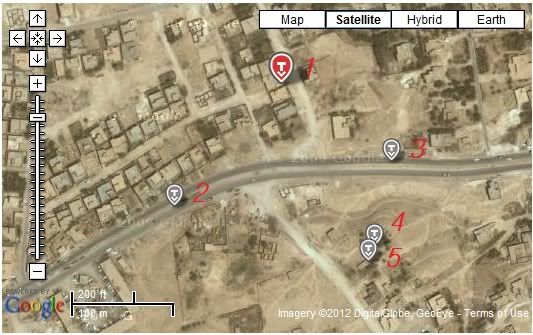
There were scores, possibly a 100s of possible places from which the IED could have been detonated. The whole area was surrounded by possible sites. ![]() (1) Ayed House, 4 unarmed men shot to death (2) Site of Taxi incident, 4 unarmed teens killed. No evidence of any connection to IED found (3) Site of the IED (4) Waleed House, 7 unarmed occupants shot including 3 women, (5)Younis House, 8unarmed persons shot including 2 women and 4 children. None of these locations revealed any possible connection with the IED or insurgents Quote:
Quote:
Quote:
Quote:
This event occurred at four locations, none of which had any evidence of involvement in the IED incident. Nor were empty casings or any other evidence from alleged insurgents firing on the marines found either. The findings of the court have been universally condemned both Internationally and within the US. Quote:
"I am totally responsible for what I write,... however I cannot be held responsible for your complete inability to understand" Last edited by senojekips; February 12th, 2012 at 21:34.. | |||||||
| | #183 |
| | Combat requires moraldecision-making, there's no getting around it. However, many leaders and soldiers feel unprepared for the life-or-death decisions they have had to make in "gray" circumstances. Their pre-deployment training consisted too often of black-or-white scenarios written by lawyers who've never had to make decisions in the fog of war. So, our soldiers learn by doing, trusting their gut instincts and character, and they generally do remarkably well. Wars are full of events that would be war crimes by legal, media and other dominant but uninformed-about-war parties. I've noticed that soldiers who are doing the fighting have their own set of ethical standards. In most cases and most situations, their ethical norms are consistent with what is expected publicly of them. Yet there are times and situations in which soldiers judge "what's right" on the ground to be much different than the public ethics. Sometimes these actions violate the "public ethics" (and some the Laws of Land Warfare)...yet I've heard well reasoned, convincing moral arguments for them. The problem is, our soldiers cannot ever say publicly what they did, much less offer their reasons, without making themselves liable to legal proceedings. As a result, the next generations of soldiers will continue to be unprepared for the complex, difficult moral decisions they will face in war. It's a catch-22. So, the profession of arms has two moral codes, the public one, based on black-and-white legal rules, that work much of the time; and a private code, known only by those who have to do the messy work of war. It's not healthy psychologically to have made difficult moral decisions that you cannot talk about publicly for fear of being punished. It's also dangerous to have such "unspoken" rules of war that differ from what soldiers are taught in formal training. For example, inexperienced young leaders can have trouble enforcing standards when they are not confident that they know the true standards. |
| | #184 | |
| | Quote:
Yes, it's all very noble to think "there but for the grace of god go I",... but you didn't, and neither did the vast majority. The same applies to many crimes, none of which get the same lack of consideration shown here. Last edited by senojekips; February 12th, 2012 at 21:37.. | |
| | #185 |
| | When discussing deployed soldiers' actions, itīs often from conventions and directives; was the action legal or not? But for the soldier on the ground, itīs not enough to relate to whether a given action is legal or not. There must be a full set of ethical considerations. That an action is legal does not in any way indicate that it should be performed. In extreme cases, soldiers are put in situations where they should be able to take other people's lives. It requires that the action makes sense. It should not just be legal; the soldier must also be able to live with it afterwards. During my missions in Iraq and Afghanistan, we did not have a formalized set of ethical considerations from above. I had therefore made my own set of rules that I controlled the use of force by: 1. To consider whether it should be performed, the action should provide a gain in the short and long term. 2. The act must be lawful in relation to our mandate 3. The Marine who pulled the trigger should be able to live with himself afterwards. So it was he who ultimately made the decision whether to shoot or not. I was confident that my Marines fund the best solution in the situation and I supported their decisions afterwards. Furthermore, I tried to articulate the act as a joint action. The fact that a Marine had shot and killed someone meant that the Troop had been deployed together. And all Troop operations were my responsibility. Last edited by 42RM; February 13th, 2012 at 12:03.. |
| | #186 | |
| | Quote:
Nobody is saying that combatants have an easy row to hoe, nor do they expect anything unrealistic from them (other than perhaps expecting them to kill people in the name of their country). If these things were excusable, there would not be laws put in place such as there are. The main problem here is with those who interpreted the laws and the fact that the sentence they imposed seemingly having no relationship to the severity of the crime. As I said earlier, there is no way that i will ever believe that Wuterich was solely responsible, everything points to a tacit agreement being in place before the event this is further exacerbated by the obvious collusion by all, to pervert the course of justice during the trial. | |
| | #187 | |||||||||
| | Quote:
You cannot detonate an IED with money but you can buy the components with it and 2.000 USD is a lot of money in Iraq. Quote:
![]() Quote:
Quote:
A nurse is not a medical examiner. The body could be helpful to determine who fired the shots. Of course it also can reveal that the victim himself had fired. Quote:
Quote:
Quote:
Quote:
Quote:
| |||||||||
| | #188 | ||||||||
| | Quote:
And just for interest, I thought you might like to read this: ![]() Quote:
Quote:
![]() This is not what grenades do. Plenty of blood splatter and bullet marks but not a shrapnel mark to be seen on the furniture. There may have been grenades used, but it appears from the evidence that most of the people were deliberately executed by multiple gunshots. Quote:
Quote:
Quote:
Quote:
Quote:
Last edited by senojekips; February 13th, 2012 at 21:36.. | ||||||||
| | #189 | ||||||||
| | Quote:
Fron the Scan Eagle Video: "1. 051119_0759/06:30-11:20 (See Segment 1: Windows or AVI formats.) Intro footage to the aftermath of IED and suppression of occupants in the white sedan at the location of Chestnut & Viper. Footage is significant for several reasons. First, the footage of the white sedan clearly shows that the vehicle was not a "taxi." It did not display the required placards and in light of what is now known about the occupants, the vehicle was never intended to act as a taxi. Next, the status of the doors on the vehicle point to at least one occupant intending to conceal his actions. The passenger door behind the driver is closed. This points to an occupant sliding across the seat to exit from the side that would have provided the most cover. Additionally, none of the occupants are located in the street and are all found in the vicinity of a dirt pile and a wall that would have provided cover." ![]() Here is a guess of the positions, remember that all the action took place within a mile radius. Quote:
Quote:
Quote:
Quote:
Quote:
Quote:
Quote:
Lt. Col. Paul Ware, an experienced Marine Corps prosecutor and judge : "No trier of fact can conclude that Staff Sgt. Wuterich formed the criminal intent to kill," Ware wrote in his October 2007 report. "The evidence is contradictory, the forensic analysis is limited and almost all witnesses have an obvious bias or prejudice." "In the post-9/11 context, the U.S. armed forces are under constant need to demonstrate professionalism and push back against allegations that they are not adhering to the law of war," said Diane Marie Amann, a professor of international law and human rights at the University of Georgia. "I don't see a legal change that's going to fix this problem," Allen S. Weiner, a professor of international law at Stanford, said of the difficulty of distinguishing innocent civilians from similarly clad insurgents like Al Qaeda militants fighting on ideological or religious grounds rather than on behalf of a nation. | ||||||||
| | #190 |
| |
Almost none of what you have said is included in the evidence for the Section 32 Charges, nor was proven. Remember we are looking at a blatant case of an attempted cover up here followed by a whitewash trial once the issue was discovered neither of which can be denied. The fact as to whether the vehicle was a Taxi or not has absolutely no bearing on the events that occurred, but regardless of your denials, it was referred to as a taxi and the court, even your own image has it labeled as a "taxi". You are merely trying (unsuccessfully) to derail the debate as you always do. And your rather lame quote of a US marine prosecutor, is the closest thing to equivalent of asking Roland Freisler about Nazi atrocities. The quote by Allen Weiner and Diane Amann did not state that he thought the finding was either fair or just. Another diversion,.. as is virtually everything you have raised, as no one skerrick of it denies the fact that the sentence given was farcical. Last edited by senojekips; February 14th, 2012 at 22:59.. |
![]() |
| Tags |
| haditha, massacre, sentence |
Similar Topics | ||||
| Court says Padilla prison sentence too lenient (Reuters) | ||||
![]() |